Whilst dieting has been around for centuries, the recent phenomenon of ‘clean eating’ has given license for orthorexia behaviours to be encouraged and celebrated. This makes it easier for individuals to unknowingly slip into disordered eating patterns and increases the risk for a serious eating disorder.
What is orthorexia?
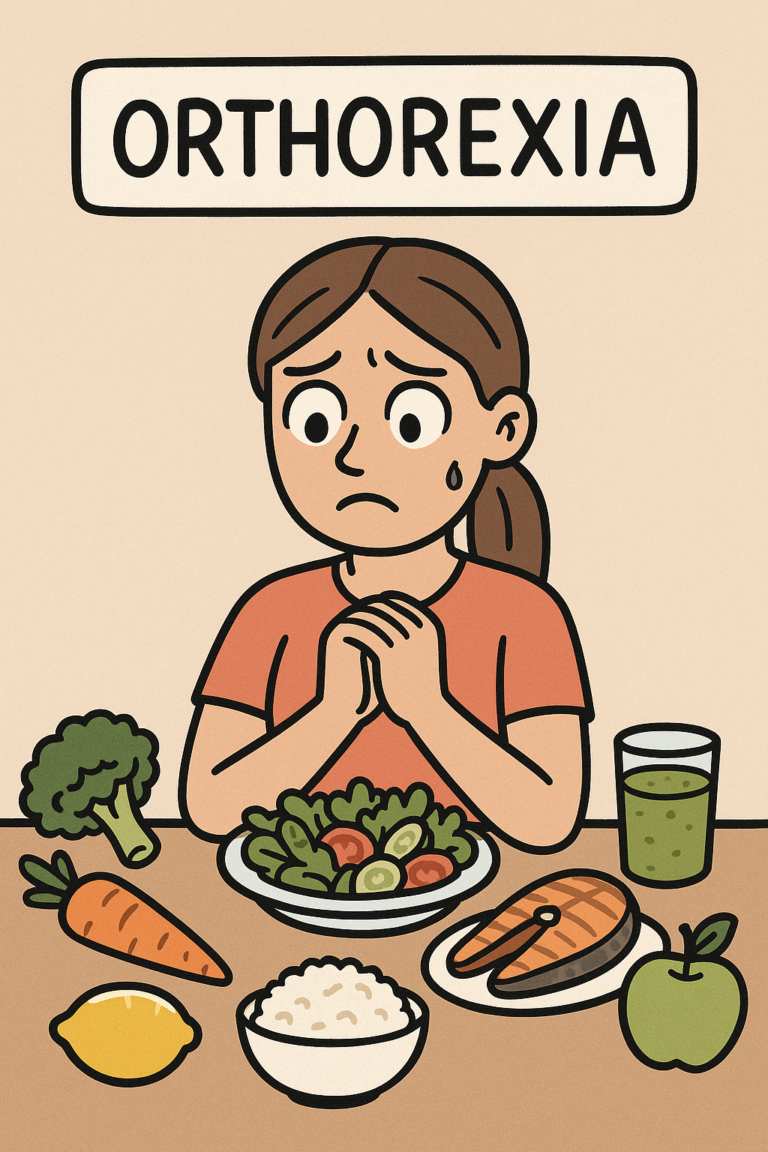
Orthorexia is a term that describes an obsession with eating healthy food. It comes from the Greek words ortho, meaning ‘correct’ and orexis, meaning ‘appetite’.
A person with orthorexia is fixated with the quality, rather than quantity, of their food to an excessive degree. Orthorexia can start with ‘healthy’ or ‘clean’ eating, then progress to the elimination of entire food groups such as dairy or grains, and then to the avoidance of foods such as those with artificial additives, foods treated with pesticides, or particular ingredients (e.g. fat, sugar or salt).
Although orthorexia is not officially recognised as an eating disorder in the DSM-5, it is a serious mental health condition that can cause extreme health complications. Although there has not yet been much research conducted on orthorexia, it seems that orthorexic behaviours and attitudes are common amongst people with eating disorders such as anorexia, bulimia or binge eating disorder.
Symptoms of orthorexia
The symptoms of orthorexia go beyond a simple preference and interest in healthy eating. A person with orthorexia may experience:
- Strong anxiety about their food choices, particularly around their diet not meeting their personal high standards of ‘purity’
- Social isolation as a person withdraws from activities and people who do not align with their strict dietary regime
- Feelings of guilt following ‘slip-ups’
- Heightened self-esteem when eating foods that are ‘healthy’
- Mood swings, anxiety and depression
These are all warning signs that the disorder is progressing into a serious eating disorder.
Diet culture and orthorexia
It can be difficult to distinguish orthorexia due to society’s fixation on ‘clean eating’.
Psychological risk factors
Some psychological risks for anorexia nervosa encompass feelings of inadequacy, personality traits of perfectionism and anxiety, a fear or avoidance of conflict, low self-esteem, competitiveness, and impulsive or obsessive behaviours.
It is important to note that psychological symptoms can also be present as the result of an eating disorder and the impact of starvation syndrome. Psychological symptoms may resolve with adequate re-nourishing and subsequent recovery.
Social risk factors
The cultural emphasis on ‘thinness’ or smaller bodies as a moral and health imperative, along with the normalisation of intentional dieting, contributes to the valuation of individuals based on outward appearance. Not conforming to these narrow standards can lead to shame and subsequently, the development of eating disorders.
Media and popular culture play a significant role in shaping perceptions of ‘ideal’ or ‘acceptable’ body shapes, further influencing societal norms and the pressure to conform.
Professions such as dancers, models, and athletes, which prioritise certain body shapes and sizes, can also be at increased risk of anorexia nervosa and other eating disorders.
Signs and symptoms of anorexia nervosa
Some of the more common signs and symptoms of anorexia nervosa are listed below. Remember, anorexia nervosa is a mental illness. You can’t tell if someone has an eating disorder based on physical appearance alone.
Mental health symptoms
- Preoccupation with body shape, weight and/or appearance
- Intense fear of gaining weight
- Preoccupation with food or food related activities
- Negative or distorted body image, perceiving self to be fat when at a healthy weight or underweight
- Low self-esteem (e.g. guilt, self-criticism, worthlessness)
- Rigid thinking (‘black and white’, ‘good and bad’ foods)
- Feeling out of control
- Mood swings
- Anxiety or depression
- Heightened anxiety around mealtimes
- Heightened sensitivity to comments or criticism about body shape, weight, appearance, eating or exercise habits
- Suicidal or self-harm thoughts or behaviours
Behavioural symptoms
- Constant or repetitive dieting, restrictive or rigid eating patterns
- Excessive or compulsive exercise
- Obsessive rituals around food
- Changes in food preferences
- Repetitive or obsessive body-checking behaviours
- Deceptive or secretive behaviour around food
Social symptoms
- Frequent avoidance of eating meals, making excuses not to eat
- Social withdrawal or avoidance of social situations involving food
- Changes in clothing style
- Impaired school or work performance